


Recently, I was asked to select a reading from the tradition for an Evensong service, and I had the opportunity to share it as part of the liturgy. My Latin has always been fairly elementary, and through lack of use, it has become even more rudimentary. Even so, I find myself returning to it from time to time, if only for the quiet discipline of working slowly through a text.
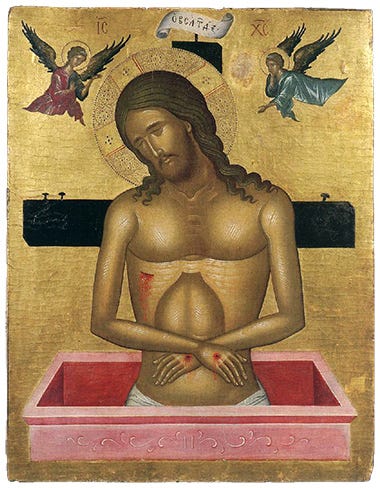
For this occasion, I selected a portion of Augustine of Hippo’s On Catechizing the Uninstructed (Chapter 4.8). Ever since I first encountered this passage, I have been struck by its central image: Christ, the humble God. It is an image that holds together what we naturally seek to separate. Rather than something abstract or distant, God’s love is embodied, enacted, and offered to us collectively and to each of us individually.
In Christ, that love is enfleshed. He moves into the center of our human world, accompanies us, and in the end bears the full weight of our alienation from God and one another. In that climactic moment, what appears to be defeat is revealed as the very means of our salvation and reconciliation: a pathway opened, here and now, and carried forward into the fullness of God’s future, which is now also our future.
I do not know a more fitting image as we enter Holy Week than this—Christ’s humility and love intertwined.
What follows is my own translation of that passage, offered not as an expert rendering, but as an act of attention and gratitude. It is, perhaps, a small way of listening again to a voice that continues to speak with clarity into the life of the Church.
May the love of God, made known in Christ, be revealed to us all in new and deepening ways this Holy Week.
Translation:
Therefore, if Christ came especially for this: that humanity might know how much God loves them, and that, knowing this, they might be set ablaze in love for the One by whom they were first loved, and might love their neighbor as Christ commands and demonstrates—he who, by loving not one who was near but one far off and wandering, became neighbor himself—then all holy Scripture written beforehand announced the coming of the Lord, and whatever has since been written with divine authority proclaims Christ and urges love. It is clear that the whole Law and the Prophets hang on these two commandments: the love of God and the love of neighbor; and not only these, but whatever has been written later for our good likewise proclaims Christ and exhorts love.
For, in the Old Testament, the New is hid; in the New Testament, the Old is revealed. According to that hiddenness, those who understand only in a fleshly way are subject to punishing fear. According to this revelation, the spiritual—those who knocked in humility then, and had even what was hidden opened to them, and those now who do not seek in pride, lest even what is open be closed—understanding spiritually, are set free by the gift of love.
For nothing is more opposed to love than envy, and the root of envy is pride. Therefore, the same Lord Jesus Christ, God and man, is both the sign of God’s love for us and the example of human humility among us, so that our great swelling might be healed by a greater and contrary remedy.
For great is the misery of the proud, but greater still the mercy of the humble God.
Therefore, with this love set before you as your end, to which you refer everything you say, whatever you proclaim, speak it in such a way that the one who hears you may, in hearing, believe; in believing, hope; and in hoping, love.1
A few thoughts regarding some parts of the translation. I nearly used a few compound words to try to get at some sense of the Latin that English doesn’t convey well in one word, or because translation loses the word-play. In the sentence “Si ergo maxime propterea Christus advenit, ut cognosceret homo quantum eum diligat Deus” rather than “loves” I considered using the term “lovingly regards” so that it would be “so that humanity might know how much God lovingly regards them.”
The most obvious question was whether to stick with “man” for the translation of homo. Given the context where I will be reading this, I opted to go for humanity and use a singular they (I know, I know). I considered “person” but thought it brought too much theological baggage related to God (divine persons, etc.) as well as humankind or human being. In the end, I thought humanity preserved some simplicity.
For the phrase “For great is the misery of the proud [man/human], but greater still the mercy of the humble God.” in Latin “Magna est enim miseria, superbus homo: sed major misericordia, humilis Deus” there’s wordplay between misery (miseria) and mercy (misericorda). Misery and mercy in English aren’t etymologically related, as mercy comes from the Anglo-Norman merci, deriving from classical Latin’s fee, wages, or price, and in post-classical Latin, “gift” (which may be why it takes on its current meaning and comes to translate misericordia). Despite that, they have a similar sound in English, and I thought that was better than trying to use some sort of compound words to hammer home a relationship that I think readers/listeners can get to just fine without the explicit wordplay. I considered “seeking-misery” and “loving-mercy” but thought they clouded more than they revealed.
Augustine, On Catechizing the Uninstructed, Ch. 4.8. The Latin I worked from can be found here: https://archive.org/details/liberdecatechiza00augu