


In the name of the Father, and of the Son, and of the Holy Spirit. Amen.
It is good to be with you all again here at the Church of the Resurrection, and it is especially good to be here as we celebrate the feast of Pentecost. I am grateful to be able to reflect on the readings we have today, and I hope to offer something that will be an encouragement to you, given the state of the world.
Among the things theologians say about Pentecost, one stands out: Pentecost is the reversal of Babel. I’ll talk more about that in just a moment, but the important thing to know at the outset is that Babel has to do with confusion and the inability to communicate—the inability to hear one another.
I don’t know about you, but I’ve certainly had my share of difficulty communicating. There’s a reason that an entire career field now exists around communications—social media managers, press officers, people who manage every aspect of personal and organizational communication. The reason for it is that everybody is trying to figure out how to communicate clearly and to be understood. This isn’t only true in the working world or in organizations. It’s also true in our personal lives. Counselors will tell you how essential communication is in a relationship. Perhaps you’ve had the experience of being at cross purposes with someone—a spouse, a friend, a colleague—where no matter what you do, it is interpreted one way when you meant it another, or you find yourself struggling to trust the sincerity of what the other person is saying.
I recall a number of times I’ve counseled people who were having difficulty in relationships. On one occasion in particular, the conflict had grown so intense that the two people involved simply could not be in the same room. I had to meet with them separately, over the course of about a week. The strangest moment came when I was meeting with the second person and, after about 45 minutes, they happened to mention a particular detail—and I suddenly realized they were describing the same events the first person had described. It had taken me the better part of an hour to recognize it, because the accounts were so different, so divergent in perspective, that the same occasion might as well have been two entirely separate events. When it takes 45 minutes for an outside observer to realize two people are talking about the same thing, it’s clear that something deeper than a disagreement is happening. There are, in a very real sense, two different realities in the room.
I think there is a great deal of this in our culture today. People find themselves inhabiting different realities from one another, and it makes communication genuinely difficult. And that brings us back to Babel—and to Pentecost.
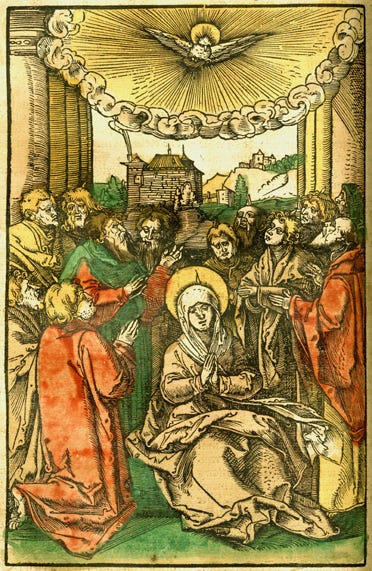
In the story from Acts, we are given this extraordinary event: the Holy Spirit descends upon the disciples in tongues of fire, and they speak and are understood by the various people who have made their way to Jerusalem. These are devout Jews—and those who feared God—who have come from across the Mediterranean world and the ancient Near East: Parthians, Medes, Elamites, residents of Mesopotamia, visitors from Rome, Cretans, Arabs (Acts 2:5-11). They speak different languages. They come from different worlds.
What strikes me about the miracle described in Acts is that it is not simply a miracle of speech. It is a miracle of understanding: each one heard them speaking in the native language of each (Acts 2:6). That is an astonishing thing.
The reason theologians point to this as a reversal of Babel is rooted in the Genesis story. We are told in Genesis 11 that the people of Babel all had one language—and not only one language but, as the rabbis interpret it, the same words, the same thoughts (Gen. 11:1).1 And their shared thought was that they would build a tower reaching to the heavens. Their pride would produce uniformity, sameness, a world ordered entirely on their own terms. The punishment for that pride was the confusion of languages, the scattering of peoples.
But there’s another way of reading Babel that I find helpful. We sometimes speak of chaos as the opposite of order—all freedom, no structure. Babel represents the opposite extreme: all order, no freedom. The pride of those tower-builders was the pride of uniformity, the insistence that everyone think and speak and act the same way.
And so what happens at Pentecost is not simply the undoing of Babel’s confusion. When God brings the church into being through the power of the Spirit, God does not do away with different languages. God does not require everyone to become the same. Instead, God empowers the disciples to speak, and empowers the hearers to hear, so that the gospel can be shared across every boundary—Jew and Gentile, race and ethnicity, culture and class—boundaries that in the ancient world were substantial enough to keep entire communities from ever truly meeting one another.
What makes the timing of this event so remarkable is the feast for which all these people had gathered in Jerusalem. They were there for the Feast of Weeks—Shavuot, in the Jewish calendar. It was an agricultural festival, celebrating the first fruits of the harvest. But it was also, and more deeply, a commemoration of the giving of the Torah—the Law—to Moses on Mount Sinai.
Consider what that means: on the very day when the people of God were celebrating God’s gift of scripture, God’s initiative in showing Israel how to live—how to love the neighbor, how to care for the alien in the land, how to live justly with one another—on that very day, the Holy Spirit descends upon the disciples, and they preach, and they interpret scripture to the crowds gathered in Jerusalem.
God’s plans, it seems, stretch out over a very long time. The Torah was given as a way—a way of ordering communal life, of respecting others, of loving the neighbor and the stranger. And now the Holy Spirit is given as the power to live that way. This is not a coincidence. It is the continuation of a single, long act of divine initiative.
If we turn to our Gospel text, we find what was necessary before any of this could happen. In John 20, we have what theologians call the Johannine Pentecost. It takes place on Easter Sunday—fifty days before the events described in Acts—and it happens while the disciples are still locked in the upper room, still afraid.
Jesus appears to them, and the first thing he says is simply: “Peace be with you” (Jn. 20:19).
I want to suggest that this is more than a greeting. In John’s Gospel, the prologue tells us: In the beginning was the Word, and the Word was with God, and the Word was God. All things came into being through him (Jn. 1:1, 3). The Word that spoke light into existence at creation has now become flesh in Jesus Christ. When Jesus speaks, something different is happening than when you or I speak. If I say “Let there be light,” nothing happens—unless there’s a light switch nearby, or I’ve got the right app on my phone. But when God speaks, it is so.
And so when Jesus says Peace be with you to those frightened, locked-in disciples, that word is not merely a greeting. It is a promise. It is a blessing. It is the gift of the very peace they will need in order to carry out everything that follows. They will need this peace—for the patience it gives them, for the fortitude, for the assurance that God is with them, whatever they will face.
Then Jesus says: “As the Father has sent me, so I send you” (Jn. 20:21).
This is a staggering claim. The disciples of Jesus are to go forward imitating him, embodying what it means to be Christlike, doing things consistent with his earthly ministry. But it is also, I would argue, a promise—because Jesus, who has been raised from the dead, who has demonstrated that he was never separated from the Father, is now saying: the same way the Father has been with me, has guided me, has sent me—that is now how I send you. You are not going alone. You are sent as I was sent.
And then he breathes on them.
I believe what is happening here, in the upper room on Easter evening, is that Jesus is planting a seed—giving the disciples an initial, intimate gift of the Holy Spirit that will flower into full bloom fifty days later on the day of Pentecost. They have to have had this first encounter. They have to have received this breath, this commissioning, this peace, before they can do what they will do when the Spirit is poured out publicly. The interior must precede the exterior. The quiet gift in the upper room makes possible the dramatic work to come.
Then Jesus adds something that is easy to pass over, but shouldn’t be: If you forgive the sins of any, they are forgiven them; if you retain the sins of any, they are retained (Jn. 20:23).
This verse is both a statement of the gravity of the authority God gives to God’s people—and a warning. We read it in parallel with the Lord’s Prayer: if we forgive those who trespass against us, we will be forgiven; if we do not, the question hangs in the air and emphasizes the gravity of the responsibility.
At the heart of all of this is a reversal—and the reversal is not simply Babel undone. The reversal is pride undone by humility.
The people building that tower were driven by the pride of uniformity, the desire to make everything the same, to impose their order on the world and on one another. The reversal of that pride is humility—the willingness to hear across difference, to make room for the other, to speak and to listen across the boundaries that pride erects.
John Stott, the great Anglican evangelical, once wrote: “Pride is your greatest enemy; humility is your greatest friend.” I believe that is true for Christians.
And Augustine puts it even more starkly in reflecting on Jesus: “Great is the misery of a prideful human; greater still the mercy of a humble God.” We see that mercy in the person of Jesus Christ—God laying down divine prerogative, taking on flesh, meeting us behind our locked doors, breathing peace upon us, and sending us into the world.
This is the foundation Jesus laid with the disciples and lays with us. Everything we are called to do has to be done in the context of striving to be more like him. That is why we are Christians.
And yet—and this is important—none of us are the same. Just as difference was affirmed at Pentecost, when people heard in their own languages and the walls between them came down, difference was not eliminated. It was, in some sense, certified by God as something good—as long as people can speak across those differences, and hear across them.
Paul’s word in First Corinthians makes this plain: the gifts of the Spirit are not the same for everyone. But they are all given for the common good (1 Cor. 12:7). All of them. For the common good.
So here is what I want to leave you with.
In a world where people can so quickly come to be at enmity with one another, where division feels like the default setting, those divisions will never be lessened as long as pride is in the driver’s seat. What we are called to do is to be humble as Jesus is humble—to trust in the peace he has given us, to rest in his presence, and to recognize that because of that peace, we can take risks. We do not have to be defensive. We can speak with those who disagree with us. We can attempt to make peace with those with whom we are in conflict. And in the end, we can forgive—even when the situation does not lend itself to full reconciliation. We can release our hold on the judgment we so easily pick up and carry.
This is what Pentecost means for us, practically. This is what it means for the church to be the reversal of Babel—not by erasing difference or demanding uniformity, but by being a community empowered to hear one another, to speak across boundaries, and to embody the humility of a God who came to us in person.
We can help the world know that it is the world by living differently as the people of God.
Amen.
Shai Held, “The Babel Story is About the Dangers of Uniformity,” The Christian Century, available here: https://www.christiancentury.org/article/critical-essay/the-babel-story-is-about-dangers-uniformity