


The Sequence Hymn begins at 19:25 below, the Gospel reading begins at 21:26, and the sermon itself begins at 23:37.
May the words of our mouths and the meditations of our hearts be always acceptable in your sight, O Lord our strength and our redeemer. Amen.
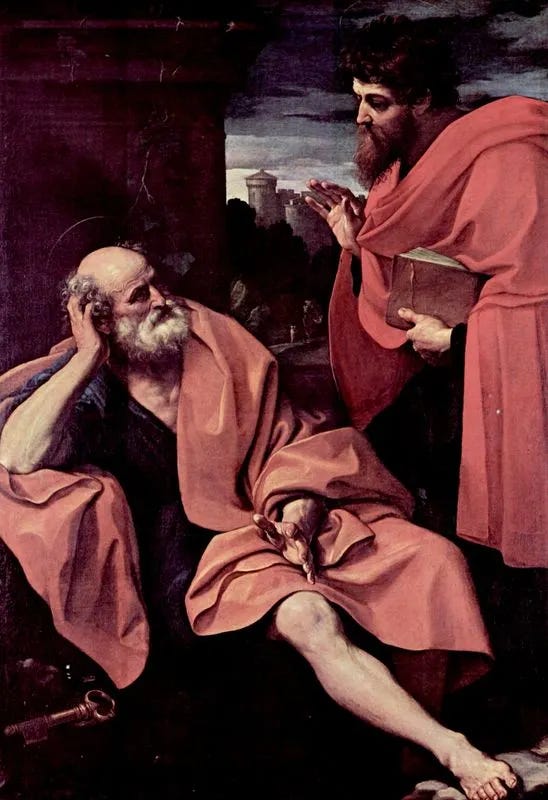
Poor Peter. In a single week, we’ve seen him go from “You are Peter, and on this rock I will build my church” to “Get behind me, Satan!”
Poor Peter. Maybe we’d say “bless his heart.”
Maybe you can see yourself in his place?
You’ve just heard something troubling from a friend, someone you love. You’re concerned. Something isn’t right. You take them aside to confront them—respectfully, you think. But it comes out wrong. You’ve misunderstood or somehow missed the bigger picture. You put your foot in your mouth, and suddenly you’re not on the firm ground you thought you were, as they push back against your sentiment.
And Peter’s is an understandable sentiment!
Jesus has foretold his own torture and death, and Peter’s response makes sense…for a friend.
“God forbid it, Lord! This must never happen to you,” Peter the friend says, forgetting what it means to be Peter the disciple. He’s not listening to or learning from Jesus in that moment. He’s the friend, the protector; not the disciple.
Paul identifies the problem. At the beginning of this chapter Paul writes, “Do not think of yourselves more highly than you ought to think.” This classical virtue of modesty serves as an envelope for what Paul says in the rest of the chapter, including today’s lesson, which speaks particularly to Peter’s misstep—the sort of mistake that we’re all prone to.
Modesty, in this framework, is proper self-respect, in keeping with moderation and sober thinking. Biblically, modesty, meekness, and humility are bound up with self-control, restraint, and the proper use of power. They require appropriate self-regard: seeing ourselves as God sees us. This means finding our worth in the right thing: being known and loved by God.[1]
Self-control should never be confused with the idea that we can control things or people outside of ourselves, least of all God. That type of control, attempting to control the uncontrollable, stems from pride and vainglory.
When Jesus confronts Peter, telling him, “You are a stumbling block to me; for you are setting your mind not on divine things but on human things,” (Matt. 16:23) he is pointing out that Peter’s rebuke echoes the temptation in the wilderness where the devil tempts him with avoiding the cross. It is also the temptation to power and control that the devil offered, exercised contrary to God’s will.
We may see here a foreshadowing of Peter in Gethsemane, where we’re told that he takes a sword and strikes the ear of Malchus, the slave of the high priest who came to arrest Jesus.[2]
Today, Paul tells us, “Do not be overcome by evil, but overcome evil with good.” Peter doesn’t realize it, but he’s committed the very human error, the very human sin, of taking the part of evil, not by loving something wicked, but by loving something good in the wrong way.
C.S. Lewis writes insightfully about this in The Four Loves, highlighting the difference between saying “God is Love” and saying that “love” undefined and general, is God. “Every human love” Lewis writes, “has a tendency to claim for itself a divine authority. Its voice tends to sound as if it were the will of God…”[3]
In our prayer book tradition, a similar thought has been summed up as “what the heart loves, the will chooses, and the mind justifies.”[4]
Jesus recognizes the danger and the implications of Peter’s protectiveness and how it’s driven by fear: fear of loss, fear of being unable to control what’s coming.
Truthfully, most who have participated in evil over the centuries are unlikely to have been lured by unvarnished wickedness. Instead, they’ve accepted, and then perpetrated evil out of an appreciation for something that, if loved rightly, would be good.
Love of culture becomes xenophobia or racism; a desire to care for and provide for loved ones becomes a willingness to see others go without. Love of country finds its darker reflection in oppressive and aggressive nationalism.
The attempt to control eventually confronts us with the temptation to violence.
If you tell others what to do, you may eventually need to force them to do it—a defining characteristic of the kingdoms of this world over against the kingdom of God. “The rulers of the Gentiles lord it over them,” Jesus says later in Matthew’s gospel, “but it shall not be so with you” (Matt. 20:26).
Paul describes the difference. Within the envelope of modesty, the defining characteristic is genuine, sincere love. This true caritas/agapé, is honest, self-sacrificing, overflowing love. It is the divine love embodied in Jesus Christ, loosed in the world via his body, the Church.
To save us, Jesus identified completely with us. God became a human being and lived a perfect human life in solidarity with us. This is God’s overflowing, self-sacrificing love, poured out without expectation or requirement. And we are called, as followers of Jesus, to imitate him and make that type of love identifiable in the way we live.
We are empowered for this, not through our own ability, or strength, or through any sort of heroic moralism, but simply because, in Christ, there is enough.
Enough love. Enough security. Enough to give. Enough.
But Paul doesn’t simply tell us to reject evil; Paul tells us what to do instead: “if your enemies are hungry, feed them” (Romans 12:20-21).
St. John Chrysostom, preaching on this passage, said that Paul knew “that if the enemy were a very brute, he would not continue an enemy when he had been fed.”[5]
It has been observed that the reason “love your neighbor” and “love your enemies” appear so often together in Scripture is that the two are so often the same.[6]
And love has a way of making caring neighbors out of former enemies.
During the Second World War, in the French village of Le Chambon, Pastor André and Magda Trocmé were leaders in a community that refused to give the location of Jewish people hiding in their midst to the collaborating Vichy government or to the Nazis. In 1943, two local military police arrived at the presbytery to arrest André. It was near supper time, and Magda told them to sit down and eat. Asked about it later, she said: “We always said “sit down’ when somebody came. Why not say it to the [military police]?” She could not control what they would do; she could choose what she would do. According to one account, at least one of the officers was tearful as he sat down at the Trocmés’ table.[7]
Scarcity is another face of the fear of loss: the fear that there will not be enough for everyone, enough for all to live, or enough to give.
This week, Tennesseans and people around the world have mourned the death of Dolly Parton. The outpouring of grief shows how deeply people identified with her and found echoes of their own lives in hers. I know that is true for my family.
Years ago, listening to Dolly, it occurred to me that her voice reminded me of my paternal grandma’s. Not her singing, but the way she talked; the colloquialisms, the cadence, the family stories. Dolly was a contemporary of my dad, and, like many, I hear echoes of my family’s story in hers.
The earliest pictures of my dad and his brothers and sisters are black-and-white photos of them outside their tar-paper shack. I still recall going with my grandma to my great-grandma Bradley’s house, and stepping over the threshold—and you had to step over it—into the living room with the packed dirt floor, with the black wood stove and the white doilies on the tables.
At four or five, I was captivated by her kitchen floor, covered with linoleum, where you could walk up and down little hills, the topography of the earth clear despite the covering. In my childhood, these things were becoming a memory for us. But it remained and remains a reality for others.
Dolly never forgot that was the case, or forgot to look where others might avoid looking.
Amid all the songs she wrote and awards she won, people are remembering how much kindness she showed others.
One story from her biography captures it. While working on a film with Sylvester Stallone, Dolly saw a homeless man and gave him her shawl. Stallone took it back and objected sharply. Dolly responded with some colorful language, pointing out that he should be grateful, because only the grace of God separated him from that man. The next day she learned that Stallone had gone back and bought the man a blanket. There was, indeed, enough.[8]
What a testimony when those who have experienced scarcity and poverty find within themselves the capacity to be generous and caring.
What a witness it is when we who have much and fear losing it follow suit and offer support, care, and love to others.
An early mentor of mine, the late Father Howard Rhys, wrote in his commentary on Romans that for Paul, salvation is, finally, being in Christ.[9]
Just that.
And those in Christ will come more and more to appear like Jesus. As Jesus says in our gospel text: “If any want to become my followers, let them deny themselves and take up their cross and follow me. For those who want to save their life will lose it, and those who lose their life for my sake will find it” (Matt. 16:24-25). Being in Christ makes that kind of risk—that kind of life—possible.[10]
Magda and André Trocmé found the strength to imitate this Jesus.
I believe Dolly found it.
Peter, the everyman of scripture, in humility, took up his cross in place of his sword, and found it. And so can we. We can identify with him, not as poor Peter, but now, as a disciple.
And it is no longer poor us. Because Christ has found us, and in Christ, there is always enough. Amen.
[1] For a background discussion of the way moderation, reasonableness and modesty function together in this passage, see Christopher Bryan, A preface to Romans, 201
[2] Ascribed to Peter in the Gospel of John but recounted without ascription in Matthew as well
[3] C.S. Lewis, The Four Loves, 5-6
[4] To see an accessible summary of The Rt. Rev’d Dr. Ashley Null’s articulation of this idea found in Thomas Cranmer’s thought, read this piece by David Zahl on Mockingbird Ministries page: https://mbird.com/theology/ashley-null-via-thomas-cranmer-on/
[5] Chrysostom, Nicene and Post Nicene Fathers, Homily XXII, 509
[6] An insight originating with G.K. Chesterton, I believe I first encountered it in the writing of Stanley Hauerwas, but I do not have a current citation. “The Bible tells us to love our neighbors, and also to love our enemies; probably because they are generally the same people.” Illustrated London News, July 16, 1910
[7] Fox, Deborah. “Magda Trocmé: A Mother Responds, ‘Hineni!’” Shofar 24, no. 3 (2006): 90–99. http://www.jstor.org/stable/42944078. Fox points out that “Magda did not judge the other to whom she owed a duty, nor did she divide those she regarded as worthy of her help from those not worthy.”
For more on the ethic of Jesus, also articulated by Paul, see Christopher Bryan, A Preface to Romans, 203
“A facet of the radical nature of the ethic that Jesus, and therefore Paul, lay out for the Christian community: avoiding vengeance and enmity with those outside the community of faith. This was something nearly unheard of in the ancient world, whether among Jews or pagans, and the idea that you would join with them in their hopes (rejoicing with those who rejoice) and lament (weeping with those who weep) was extreme and grounded in the peculiar nature of the humility commended by Jesus in the sermon on the mount and articulated here by Paul. In Paul’s day, both Jews and pagans tended in general to regard those who were outside their particular communities as being, by that very fact, somewhat less than fully human. Certainly Paul was not the only Jew to see in the Deuteronomic declaration of God’s prerogative in taking vengeance grounds for forbidding personal vendetta: but generally, as Kent L. Yinger has shown, such prohibition is applied within the community of faith.”
[8] https://parade.com/entertainment/dolly-parton-once-cursed-out-sylvester-stallone
[9] Howard Rhys, The Epistle to the Romans, 232. Fr. Rhys was the retired New Testament Professor at Sewanee when I was a seminarian there. I was able to visit with him on a number of occasions and got a lot out of our conversations, though he considered himself beyond the time of being a spiritual director, the reason I first reached out to him.
[10] Back to Lewis’ reflection on love, he writes that “our willed imitation” of God in this life “as distinct from any of the likenesses which He has impressed upon our natures or states—must be an imitation of God incarnate: our model is the Jesus, not only of Calvary, but of the workshop, the roads, the crowds, the clamorous demands and surly oppositions, the lack of all peace and privacy, the interruptions. For this, so strangely unlike anything we can attribute to the Divine life in itself, is apparently not only like, but is, the Divine life operating under human conditions.” C.S. Lewis, The Four Loves, 5