


[Note, if you would like to watch the video of the worship service, the YouTube video is below. Go to 12 minutes to hear the Gospel and the sermon following]
It’s good to be with you all again here at St. Ann’s this morning, and I’m happy to be talking with you about our text today. I want to highlight a theme that really emerges from our Old Testament lesson from Genesis and our Gospel text—although you can certainly, after this morning, look and see it also in our Epistle lesson. But I want to begin talking about the theme of laughter, and what laughter tells us about the character of God: how the character of God is revealed to be consistent through Scripture, and is revealed most fully in Jesus.
So, laughter is something that’s a universal characteristic of human culture—and in fact, there are other primates that seem to laugh—but for humans, laughter functions in various ways. I think about Stephen Colbert talking about growing up in a family with eleven children, and how he said that his family was a “humor-cracy”: the person who was the funniest at the time in the room was the one who was sort of at the top of the heap. And so this prompted him to try out his own comedy stylings as he grew and as he aged. Of course, being the youngest, it didn’t hurt to be able to defray the attention of older siblings with jokes.
And this is something that we see in our own lives. You may think about the different ways humor and laughter can cut—how it can be a positive thing or a negative thing, how it can alleviate stress and anxiety or be the source of stress and anxiety. Whether you are laughing with someone or laughing at someone, whether people are laughing with you or at you, all these things can serve to hide in different ways. Laughter affects human community, and it affects us as individuals.
And it’s interesting to me that laughter plays a prominent part in our Old Testament lesson. In fact, it’s a theme that begins the chapter before the one you were reading. You were reading chapter 18, but the theme of laughter actually begins in chapter 17, when God is speaking to Abraham. God tells Abraham—predicts to Abraham—that He is going to give him and Sarah a son, and even tells him, “You will call his name Isaac.” Isaac means “he laughs.” And in Hebrew names, when there’s no antecedent, it’s seen as referring to God. So Isaac means “God laughs.”
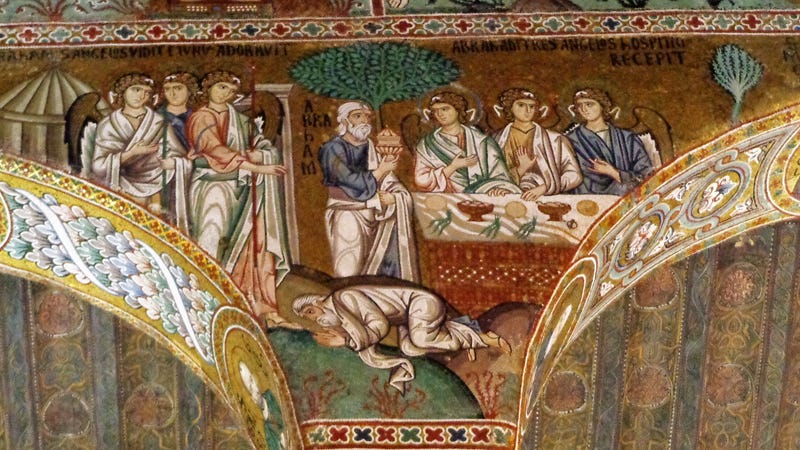
And so this theme starts in chapter 17: when Abraham hears this, he falls down on his face and laughs, because he can’t believe that this is a realistic promise. Chapter 17, verse 17—Abraham falls on his face and laughs at God’s promise and prediction that they will be given a son whose name will be “God laughs.”
Now hold on to that theme of “God laughs,” because then in chapter 18, while Abraham is at the door of his tent, we’re told that God visits him. Now, this wouldn’t be such a shock for those who’ve been listening to the story, because God has already been conversing with Abraham, as we just saw a chapter before. And yet Abraham—the narrator tells us God visits Abraham, and we’re let in on something that Abraham doesn’t seem to know in the narrative, at least not yet. Because Abraham looks up and he sees these three strangers standing outside—three men. He doesn’t know them. And he gets up and goes and greets them. He kneels on the ground, and he offers them water and bread. He tells Sarah to prepare a meal.
And it’s unclear whether Abraham actually knows that these three visitors are a divine visitation at that moment. Rabbi Shai Held, in his commentary on the Torah portions for this section of Genesis, comments on the fact that the way it appears is that Abraham actually leaves a conversation—an interaction with God—to go and care for strangers. And he comments on that: what does this mean?
That he would leave the presence of God—that you would leave a conversation with God Almighty—and go and take care of strangers, visitors? He uses this to articulate the importance of hospitality and caring for the stranger in the biblical tradition, and he highlights the fact that in the stranger, in the neighbor, in one another, we encounter God.
So you see, it appears that Abraham may have been leaving the presence of God—to those who aren’t let in on the full character of the narrative—and yet, by going to care for the stranger, he encounters God. And that is true for you and I today as well. Because all of us, all human beings, are created in the image and likeness of God. We’re all worthy of love and care; we’re all worthy of hospitality.
Then the interesting thing happens in the narrative. Abraham’s talking to the three strangers, and then he’s asked, “Where is Sarah, your wife?” How do they know who Sarah is? How do they know who his wife is? That’s the glimmer in the narrative—that these are not simply three travelers. Something else is happening here.
So they have this conversation, and when Sarah is asked about—when she hears the prediction again of the birth of a son to them—we’re let in on some of Sarah’s interior thoughts. She thinks about her and her husband’s advanced age, their stage of life and health, and she thinks: this is impossible. She laughs. And I love this exchange, where the lead figure of the three asks Abraham—editing some of Sarah’s thoughts, not revealing completely her interior thoughts—”Why did Sarah think that it is impossible she would bear a son, and laugh?” And I love Sarah’s response: she did not laugh. And then, the end of our lesson today: “Oh, yes, you did laugh.” I love that. Oh, yes, you did laugh.
What is funny about this is, again, this theme of laughter, encounter with God, and three strangers—and God getting the last laugh. Who gets the last laugh? God gets the last laugh.
But here’s the thing: God’s laugh is a laugh of joy into which we are invited. God’s laugh is a laugh of joy into which we’re invited. There are different types of laughter that are already shared. Abraham’s laughter and Sarah’s laughter was, I think, wry laughter—perhaps laughter of resignation about the way the world is. Laughter not so much targeted at a disbelief in God’s abilities, but simply acceptance of the way things are. And yet God’s laughter—his laughter of joy and hope—is revealed in the birth of Isaac, whose name is “God laughs.”
And we’ll see later in Genesis, in chapter 21, Sarah will say that she has laughed, and all who see will laugh with her—being invited into the joy God has made possible in a situation that seemed impossible. And that is a key thing to hold on to. Because in our lives, one of the key things to remember is this: the very thing that we think makes it impossible for God to love us, the very thing that we think makes it impossible for us to serve God, the very thing that we think makes it impossible for us to do what God has called us to do—that is the very location of God’s grace. Because what we discover in the joy of God and the coming of Christ is that God loves us not in spite of those things, but with those things that make us who we are. God loves us, full stop. No ifs, ands, or buts. God loves you, full stop.
And so we see this character of God revealed in various ways. There are different types of laughter, as I’ve said. There’s the wry laughter of resignation at the way things are. There’s also other types of laughter in the world—other types of laughter in response to God’s promises and what God is doing in the world. What we might call derisive laughter, or the laughter of ridicule. This would be folks who see God’s promises, who see the promise of the incoming kingdom of God, and laugh at it—because their ridicule is masking fearfulness. Their ridicule is masking fearfulness, because perhaps they have decided that the way the world is is actually good for them, actually profits them.
These would be the folks who think that their power, their station, their ability to alienate and lord it over others, to oppress others, would be threatened by the world as God wills it to be. And so they laugh at God’s promises out of fear that they might actually come to fruition—because if the reversal that God promises happens, then those who have station over others, and make themselves seem better than others, are not going to be able to continue to do that. And so they laugh.
This would be the sort of laughter that sometimes is expressed as a sense of saying that Christians are naive—that those who would follow the Sermon on the Mount are naive, and just can’t exist in the way the world is. And underneath that criticism is a sort of fearfulness, as I’ve already shared—that something could be lost. And yet the promise of God, the promise of joining in that joyful laughter, is that nothing that would be lost in this reversal of the way the world functions is actually worth being upset about. Because what God promises—in bringing all peoples into unity with Him and with one another—is so much better than what would disappear with the coming of God’s kingdom. And so the God who laughs in the promise and the fulfillment of the promise of Isaac is the same God who comes to us in the person of Jesus Christ.
And so we see Jesus in his ministry. He looks at the people, and he has compassion for them, because they “are like sheep without a shepherd.” And this is a comment that actually strikes the heart of this contrast between the way the world is and the way the world should be. Because in the Bible, a shepherd is both a political and a religious leader, and throughout the prophets and Scripture, God challenges the shepherds who have mistreated the people. In Jeremiah: “Woe to the shepherds who scattered and destroyed the sheep of my pasture.” And there, God promises that He will be the shepherd instead of all these others who have done things for their own good rather than the good of the people.
And so what’s intriguing to me in our Gospel text is not only this consistency in God’s character—that the God who invites us to the laughter of joy looks at the plight of the people and has compassion—but that that compassion is what moves Jesus to send his disciples out.
Now, this is important for us as Episcopalians. I know that in our tradition there is a—let’s say—polite reluctance to talk about things like evangelism. And I understand that many of us have maybe been on the receiving end of some hurtful and challenging attempts at evangelism or proselytization. And yet I want to highlight that Jesus sends the disciples out to the lost sheep of the house of Israel—sends the Twelve—out of his compassion for the fact that they were like sheep without a shepherd.
This is not something Jesus is doing to empower and bolster the disciples, to give them station. This is something that Jesus commands the disciples to do: to go and proclaim the coming of the kingdom—precisely because the ways of the world are not working for everyone. Precisely because the injustice of the world has left many behind. Precisely because the alienation of people from God and people from one another snowballs and creates tragedy. And God has compassion in God’s heart for the people, and the coming of God’s kingdom is intended to be in contrast to the kingdoms and the ways of the world.
In other words, even though we’re using the word “kingdom” when we refer to God’s coming way in the world, what we’re referring to is a different way of living and being. And so when the disciples are sent out, they’re healing, they’re casting out demons, they’re doing these works of power that help the people, that serve as a testimony and a witness to the goodness of God.
And so what I would encourage you to think about today is this: when you are sent out from this place—after having received the sacrament of Christ’s body and blood, and being reminded of the forgiveness and the love which was yours before you could do anything at all—take that with you, and offer it to others. Take that assurance, that peace, that comfort with you, and offer it to others. Because that is what the good news of the kingdom means.
It is not about coercing people. It is not about getting people to sign on the dotted line. It is not about sort of counting up, you know, the number of people whom you have convinced of something. It is about the peace and the joy of understanding that God loves you, and God loves them.
This is something that we have at the heart of our tradition. Some of you may remember the words of this particular hymn—it’s 489—and the last verse of it says that in Christ, God came to “win us by good will,” “for force is not of God.” That’s the end of the verse: “for force is not of God.”
And that hymn—it sort of blew me away when I was first looking at it. I noticed, I looked at the bottom of that hymn in the hymnal, and it said it was translated from something called the Epistle to Diognetus, which was written sometime from 130 to 230 AD. And a contemporary translation will not say “force is not of God,” but say “coercion is not of God.”
So this is an insight that’s been in our tradition—perhaps observed more in the breach than in the following of it—but it is something for us to hold on to: to know that when we are invited to share the good news with others, it is good news that is not coercive, that is not backed by force. It is simply about hope in a future in which God calls us to join in God’s joyful laughter and love for the people and the world that God created.
Amen.