



Scriptures: Isaiah 53:4-12 and Psalm 91:9-16 • Hebrews 5:1-10 • Mark 10:35-45
The sermon begins at 2:46
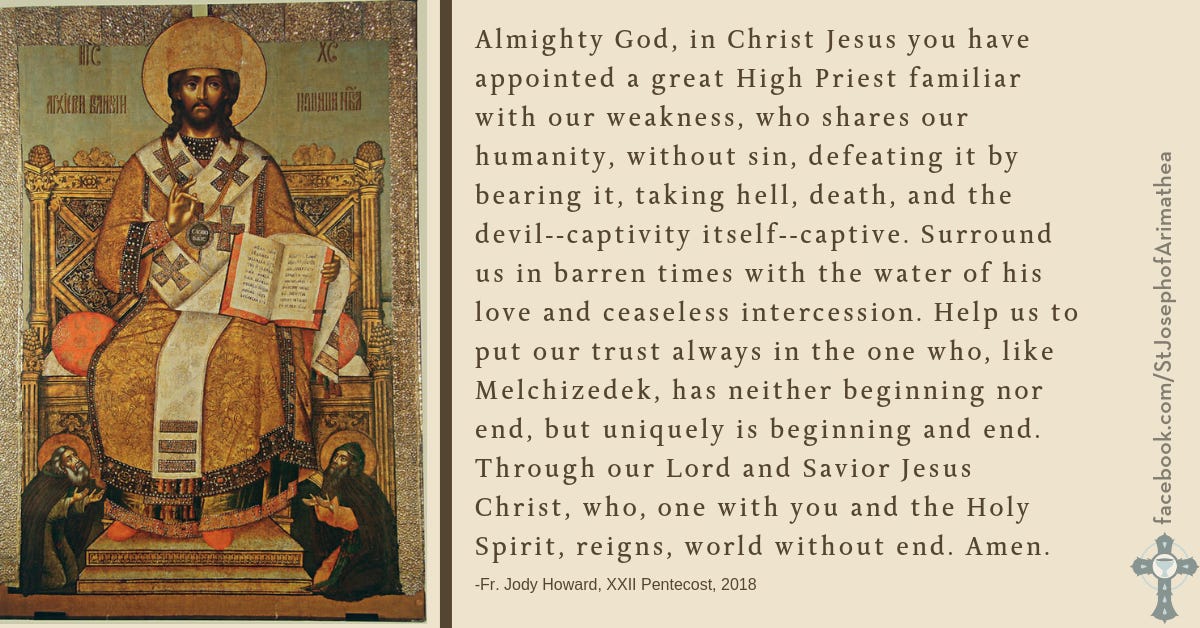
Let us pray.
Almighty God, in Christ Jesus you have appointed a great high priest familiar with our weakness, who shares our humanity without sin, defeating it by bearing it, making hell, death, and the devil, captivity itself, captive. Surround us in barren times with the water of his love and unceasing intercession. Help us to put our trust always in the One who, like Melchizedek, has neither beginning nor end, but uniquely is beginning and end. Through our Lord and Savior Jesus Christ, who, one with you and the Holy Spirit, reigns, world without end. Amen.
Amen. Please be seated.
I think it’s a fair statement to say that James and John had no idea what they were asking for when they approached Jesus, as we hear in our gospel text today.
They go to Jesus and they ask, “Lord, we want you to do whatever we ask of you.” And Jesus, rather obligingly, asks them back, “What is it you would have me do for you?”
And they say, “We want to sit on your right and your left hand when you come into your glory.”
Jesus tells them, “You don’t know what you’re asking. Are you able to drink the cup which I will drink, to be baptized with the baptism with which I will be baptized?” And they say, “Yes, we will.”
Not knowing, despite Jesus’ repeated foretellings of what is going to happen to him, despite his predictions of his passion, two of which they have heard thus far, they jump in and say, “Of course we can.”
And Jesus knows what he’s talking about when he talks about the cup from which he’s going to be drinking, the baptism, the overwhelming that he’s going to experience. He’s going to drink from the cup of persecution and torture, and he will be overwhelmed and be baptized in death.
And so they jump in and say, “Of course. Yes, we will.” And he gives them what they’ve asked for. He tells them, “You will drink from this cup. You will be baptized in this baptism.” But of course, Jesus will have transformed both by the time they share it. But they don’t know that.
And then Jesus tells them, “But as to who will sit on my right or on my left in glory, that I cannot give, for it has already been prepared for someone.”
Now, there are a number of different traditional interpretations of this. But if you recall elsewhere in the Gospels, in the Gospel of John in particular, Jesus talks about how he will be glorified: “And I, when I am lifted up, I will draw all people to myself” (John 12:32).
The literal interpretation of that, and there’s more than one, one is just simply the proclamation of the gospel, lifting Christ up. But the literal interpretation is that when Christ is crucified, that that is his glory.
And so one traditional interpretation of this, who will be on his right, who will be on his left, and it has already been prepared, is that it is the other folks, the thieves on the cross, that that is who it has been prepared for: to be on Christ’s right and on his left, in his glory, as he’s glorified on the cross (cf. Luke 23:32–43).
This is how the logic of God defies the logic of humanity. We don’t think of glory as consisting in a cross. We don’t think of a place of honor as being on the right and left of a condemned criminal. We don’t think in these terms, and yet God transforms these things and works in the midst of human cruelty, defying it, transforming it, and somehow out of it brings the peace and the glory and the grace and the freedom of God, which is then offered to us.
So John and James don’t know what they’re asking for, but what they receive is salvation, and what they receive is the grace to endure whatever comes their way in life, the persecutions that Christ knows will come, because Jesus has endured it, because Jesus has freed them from sin, and because Jesus, the love of God revealed, God in the flesh, promises to be with them always.
So they get way more than they bargained for, both in the negative of what they will experience and in the positive of what God gives. And this is true for the early church. This is true for us today. But it is a lesson that we have to keep relearning.
And so I want to use Jesus’ exchange with James and John as a window to look upon the context for another of our readings today, and that is our selection from Hebrews. Because what seems to be going on in this text from Hebrews is that the author is dealing with a community that is wrestling with what it means to have faith in Jesus in the midst of persecution and suffering, what it means to hold fast to the faith, and not only to hold fast to the faith, but to actually move forward in faith in the midst of persecution, losing one’s status in society, and perhaps losing one’s life.
Now, you should know that we actually don’t know who wrote Hebrews. There’s a very interesting history and interpretation about the authorship. It seems to have been written, there’s debates about this, but it seems to have been written probably not as a letter, but recorded as a sermon. It’s referred to as an exhortation in the midst of the text, probably as a sermon to a mixed community of Jews and Gentile Christians, probably in Rome.
And what makes that context interesting is that the Western Church was the slowest to adopt Hebrews as a canonical text. Now, why might that have been? To me, that makes it seem likely that it actually was written to the community in Rome, because the author, the preacher, whoever it is, is challenging this community to whom they’re writing, to whom they’re preaching, to stand fast in the faith in the midst of persecution.
And so in the East, as the letter was copied and sent around, it became seen as canonical first in places where it did not represent the people that it had been written to. And it was also in the East that it was first ascribed to the Apostle Paul. But the earliest copies of it and the place where it seems to have been written resisted not only its canonicity, but also ascribing it to Paul. So probably it wasn’t Paul.
But what’s interesting about that is, within the text, we see echoes of Pauline theology. We see echoes of John as well. And so people have debated, “Who could this be?” Luther, I think, thought it was Aquila, of Aquila and Priscilla. Some people have suggested it could have been Priscilla. And one of the reasons to believe that as a possibility might be because of the fact that we don’t have a name ascribed to it. Some people say, “Well, if it was a woman at that time, perhaps they just conveniently lost the name.”
But we don’t know.
But what we do know is that whoever wrote it was very well versed in the Hebrew scriptures, in the Old Testament, and they had very good Greek. There are many scholars who consider the book of Hebrews to be the best example of Greek writing in the New Testament. And so they were very well versed. They were knowledgeable. But overall, they were concerned for the community to whom they preached, to whom they wrote.
They were concerned because people seemed to be giving up on the faith they had in Jesus in the face of persecution. And so at the heart of this text are two things: one is an argument about how Jesus is better than any alternative, and the other is an affirmation of the fact that Jesus’ love, that God’s love as revealed in Christ, continues with us forever.
It is out of the book of Hebrews that we hear the affirmation that we are surrounded by so great a cloud of witnesses, that this community brought together by the love of God in Christ will endure. So don’t give up on your faith. [Hebrews 12:1]
So what does the author do? Well, beginning last week, you heard these words last week in chapter four. The author says, “We do not have a high priest who is unable to sympathize with our weaknesses, but we have one who in every respect has been tested as we are, yet without sin” (Hebrews 4:15).
So that verse is actually setting up the argument for today in chapter five of Hebrews, where the author, the preacher, gets into this comparison between Jesus’ high priesthood and the high priestly office as it existed prior to Jesus’ incarnation and ministry.
So you should know that first, the author talks about all the various other things that people might put their faith in. Angels. Maybe you want to put your faith in angels. Well, God made him but “a little lower than the angels” for a little while, but then elevated him, elevated Christ, and put a crown on him. That’s what the author’s saying, applying verses from the Psalms, saying that Jesus was, for a little while, made a little “lower,” you can put that lower in quotation marks if you want, than the angels.
In other words, the Word becoming flesh. But that was just what it appeared, and it was only temporary, because Christ was then going to be glorified and be given a crown. So Jesus is better than the angels. If you’re looking for somebody in your corner, it’s better to have Jesus than the angels.
Then the author goes and talks about Moses, and talks about all the wonderful things that Moses did, and says Moses was a faithful servant in the household of God. Then the author will say, “And yet Jesus is the Son who is head over the household.” Moses was a servant within, a faithful servant within the household. Jesus is the Son who is heir, who is over the household.
And then finally, we get this argument in the section today that we hear about Jesus’ high priesthood. That the high priests, as they had functioned, were just like you and me. They were chosen by God. They were sinners like us. And therefore, before they could offer sacrifice for the people, they had to offer sacrifices for themselves so that they could be pure. Jesus doesn’t have to do that, the author says.
And also, the people who are served as high priests, the office turns over and turns over and turns over. They serve for a set period of time. They’re term limited. Jesus is not. Jesus is high priest forever, and that’s where this reference to Melchizedek comes in.
You see, Melchizedek’s this really interesting figure in the Old Testament. He’s the priest of Salem, which is the old name for Jerusalem. And when Abraham’s wandering around, Abraham meets Melchizedek, and Melchizedek blesses Abraham. And then Abraham gives a tenth of all of his goods to Melchizedek (Genesis 14:18–20).
And so the author of Hebrews pulls that in and says that, in Abraham, all of Israel tithed to Melchizedek, and that Melchizedek, in blessing Abraham, is sort of fulfilling this role of fulfilling God’s intent by blessing Abraham. [Hebrews 7:1–10]
But Melchizedek is a figure who just sort of appears and disappears. We don’t know what happened to him before. We don’t know what happens to him after. So he’s a figure without a beginning and without an end.
So the author of Hebrews, the preacher, says Jesus is like a priest like Melchizedek, because Melchizedek, for all we know, Melchizedek’s still around. We don’t know. It’s not in the text. We know Jesus is around, because Jesus has no beginning. Jesus has no end. Jesus is going to be a high priest forever according to the order of Melchizedek, according to someone who has no beginning, no end, and is there for eternity.
And later, what’s going to happen is the preacher’s going to say, “Well, what is Jesus doing as a great high priest? What is Jesus doing at the right hand of the Father? What is Jesus doing in the heavenly temple?”
Well, Jesus is doing what a high priest does. Jesus is offering intercession for you and for me. But an intercession that doesn’t require any atonement on his part for his own sins, because he has none. Intercession that isn’t time limited, because he’s going to be doing it from here on out. Intercession that isn’t limited in its effects, because the one offering it is in no way limited. [Hebrews 7:25–28; Hebrews 8:1–2]
And so the message of Hebrews is really a message of hope. It is a challenge to the folks who are leaving their faith behind. Elsewhere in the text, the author challenges them and says that by rejecting their faith once they’ve received it, they’re crucifying Christ anew.
But while it’s a challenge, the challenge is backed up with hope. Don’t give up on what you’ve heard because this is true. Don’t give up on Jesus because Jesus is the only one who’s going to fulfill what you need. Jesus is the one who’s going to be with you through the times of trial and persecution.
Now, it may be difficult for us to identify with the congregation to whom the preacher was speaking, who received this letter, if indeed it was a sermon turned into a letter, because in America, we generally, as Christians, aren’t persecuted in the same ways.
But we can look around at the news and we can see places in this world where our brothers and sisters in the faith do suffer because of the name of Jesus, where they do take their lives in their own hands by going to church, where it is something that causes danger for them.
And so we could perhaps put ourselves in that situation, the fearfulness and the anxiety that we might feel. Would it not be easier just to let go, to be safe, to be protected?
I think we can understand the temptation that these ancient Christians felt when they were under threat, or even the threat of losing their status in society or their business deals. Because after all, what are all those things? We have responsibilities to our families, right? We want our kids to go to good schools. We don’t want them to suffer by association with us. We want to be able to provide for our families.
So maybe we could understand some of the anxieties they had if their persecution consisted of that, which it very well could have as well.
So the author is saying all these things you’re tempted to go toward because of this persecution, this isn’t going to solve your problems, not your real problems. Because if you’re looking for a patron, if you’re looking for someone to get you back to unity with God who created you, the angels aren’t going to be good enough. Moses isn’t going to be good enough.
Moses is great, but Moses was a servant in the household, not the heir. And if you want to be the heir, go with the Son. Go with Jesus. And the priests, these other priests, they’re just like you and me. But Jesus is like us, and so he can identify with us in our weaknesses. But Jesus is unlike us in that Jesus does not sin, and Jesus is eternal and intercedes for us always.
And so for us today, maybe we have different things that tempt us away from the faith, different things that challenge us. You can, I think, for much of this argument, insert whatever thing you would think might be better than Jesus, and I think the bulk of this argument would work.
But there’s one key temptation that I think is there for us today that was not really an option in the ancient world. People just didn’t conceive of it in those terms, and that is what we would call atheism today. That, I think, is probably the big challenge for those of us in our faith. When we endure tragedy, when we endure persecution of one form or another, whether it be by other people or just by circumstance, the thing that threatens our faith is losing it, not misplacing it necessarily in some other divine thing. It’s just giving up.
Now, there’s this old joke some of you may have heard. It’s about a person who moves to Ireland and is going to the office to get all their paperwork in order, and they have left blank the category on the form that says whether they’re Catholic or Protestant. They’ve left the religion blank. And so they go, and they hand the form to the person at the front, and he says, “Well, what’s your religion?”
They say, “Oh, I don’t have a religion. I’m an atheist.”
And the person says, “Yes, but are you a Catholic atheist or a Protestant atheist?”
So there is some truth in the joke, not only the satire about divisions in Ireland, but there’s this other truth that when we reject faith, it is always a particular understanding that we’re rejecting. And there are some authors, some Christian authors, who have written about the new atheists, as they’re called, Richard Dawkins and so forth, and have pointed out that they’re a particular sort of atheist. These are Christian atheists.
Now, this is what the author means by that. And I don’t want to sort of label folks with labels they might chafe at, so God knows they might chafe at being called a Christian atheist. So let me get underneath the terminology and what’s going on here.
Often amongst the new atheists, what you’ll hear in their arguments against God, well, of course, there’s a scientific side that says, “Well, you can’t prove the existence of God. We don’t need God.” Stephen Hawking’s posthumous book, right? He said, “There’s no need to posit the existence of God.” He does this thing I can talk to you about later, but his concept about the fact that if you can say pi doesn’t exist, then you can say that there’s no need for God. We can talk about that.
I think he misunderstands at least one of the major tenets of classical Christian theism, if that’s what he thinks God is about. But some of it is rejection based on science.
But at the heart of many of the arguments is really the problem of evil. If God exists, and God is a loving God, why do these tragedies occur? Why do people suffer? And this is argued, you can see it in The Brothers Karamazov, you can see it in Hollywood films, you can see it all over. This is really the big argument against belief in our culture.
And yet, it’s not really an argument against belief in a generic God. You already have to have decided that it is of the essence of God to be good. You see? There’s a prior assumption. You could be a theist and think that God is a souped-up version of some sort of pagan deity that is capricious and enjoys making humanity suffer in this or that way. And you can believe in a God like that. Humans have believed in gods like that. Just read Greek mythology.
And yet the argument is that, “I don’t believe because a good God, a loving God, would not allow this.” So what God are you disbelieving? So that’s why the term Christian atheist.
But if folks are rejecting a belief in God because they don’t see how God has acted or could act in a world where there’s so much hatred and suffering, well, then at least from a Christian perspective, the answer is Jesus. Because we believe, as followers of Jesus, that God has acted in the person of Christ.
And so what does that mean? Well, it should be comforting for us to know that in the midst of a world in which so much evil still exists and is still ongoing, that Christ is there, in the eternal presence of the First Person of the Trinity. Christ is there, humanity in the heart of God, interceding for us at every single moment, praying, interceding, asking that things would be better for us. And not only there, but here with us right now.
So the book of Hebrews is a challenge to losing one’s faith, but it offers a hope: our great high priest, eternal in the heavens, the pioneer who shows us what faithfulness to God looks like, and the perfecter of our faith, who gives us the ability to do what we could not do on our own.
And so I give thanks that whoever it was who preached this sermon, we call the Letter to the Hebrews, or wrote this letter, I am thankful that they did it, because we have it today, and it is still a message we need to hear: that Jesus, as the incarnate Word of God, the love of God made flesh, shows us the character of God as one who loves us and wants to be with us, and wants us to be with God.
Amen.


