


To view the full service, watch on the Church of the Redeemer’s YouTube page.
May the words of our mouths and the meditations of our hearts be always acceptable in your sight, O Lord, our strength and our redeemer.
Just to let you know, this passage is not Jesus’s statement on separation of church and state.
This is a contest, a conflict that has been ongoing for a while between Jesus and a certain group of the Pharisees, and in this case the Herodians. Soon after this, we’ll see the Sadducees again. In other words, Jesus has unified a great number of disparate groups in their opposition to him: folks who disagree a whole lot about a whole lot of things are agreed about the dangers of Jesus’s ministry and teaching — the danger to their own authority and to the way they want things to go. And this has been going on for a while now.
You may recall that over the past few weeks we’ve heard a number of parables of judgment; those immediately precede this exchange. And of course, it all begins when Jesus enters Jerusalem. There’s the triumphal entry, and then he is confronted in the temple with the question, “By what authority do you do these things?” And he has that exchange and questions the leaders, and refuses to answer them because they will not answer him — because they’re fearful, and they’re afraid of the crowds who like Jesus. But they’re again trying to figure out how to rid themselves of Jesus and his teachings and his ministry.
And so Jesus, after being confronted by them, tells these three parables of judgment. The parable of the two brothers, where one initially says yes to the father but then doesn’t do what’s asked, and then the second, who initially says no but then does what was asked. The parable of the wicked tenants, who end up killing the messengers of the vineyard owner. The parable of the wedding feast, with the wedding garment. And then today, this conflict — this contest, if you will — where they come trying to entrap Jesus. Because they recognize that in each of these parables of judgment, the folks who are under judgment are those who are in authority, who have not lived faithfully. And they recognize that they’ve been condemned by Christ’s teachings, and they’re not too appreciative of that. And so they come to him thinking that they can entrap him with this question.
It’s rather sneaky, because they know that if he tells them yes, go ahead and pay your taxes, he will have alienated a great swath of the people who have been listening to his teaching. And they know that by saying that, he may in fact be violating his own conscience and his own teaching, because Jesus tends, in his teaching, to align himself in many ways — actually, ironically — with the Pharisees that he’s often in dispute with. And one of the things that the Pharisees had some discomfort with was the paying of this tax to the Roman emperor. It was known as the census, and it was a head tax that everybody in the empire had to pay.
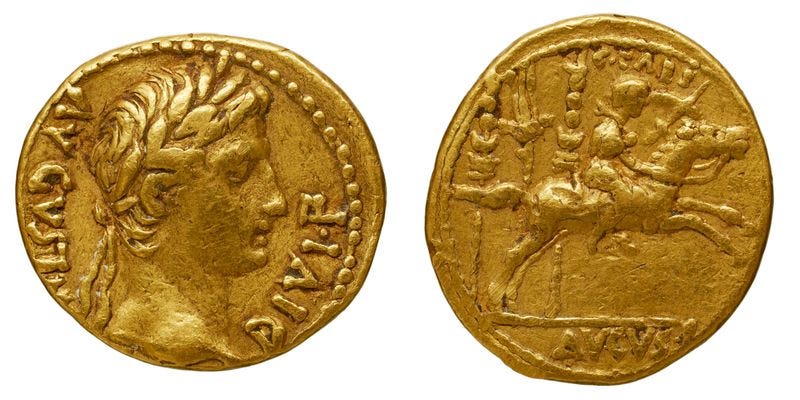
But a lot of Jewish people had some discomfort with it, in part because they viewed the coin itself as being idolatrous. Because in the ancient world — you know, look at the coins in the U.S. We have the heads of presidents on there. Unless we’re really, really super partisan, we tend not to think that the presidents on the coin are divine. But in the ancient world, they believed that the emperor was divine, had divine authority. And so this coin — the emperor was Tiberius at the time — would have said “Tiberius, son of the great,” or “the divine, Augustus.” And so it would have been claiming divine authority for Tiberius.
And so the irony of Jesus’s response, and the wisdom of his response, is it does a couple things. You’ve got these various factions: the Herodians, who would have been perfectly fine with paying the taxes because that’s their political base; you’ve got the Pharisees, who are critical of the taxes. And yet they’re aligned against Jesus.
Jesus asks them, “Whose image is on the coin?” They’re in the precincts of the temple, where you’re not supposed to bring idolatrous images. But what do they have? Here’s the coin. The very people trying to get Jesus to say “Don’t pay the taxes,” so that he would be in trouble with the Romans, or to say “Go ahead and pay the taxes,” so that he would be betraying his own teaching and alienating the people — the very people who were trying to entrap him — they had the coin in the precincts of the temple. The Pharisees, who were trying to entrap him, who are critical of it — here they are, carrying the coin in their purse.
So this is why it’s unsurprising that Jesus says to them yet again, as he does often, “You hypocrites! Why are you trying to entrap me?”
And then Jesus gives them his response. Whose picture is on the coin? Well, of course, it’s the emperor’s. Whose words are on the coin? The name of the emperor. The title of the emperor. Jesus says, “Therefore, give unto the emperor the things that are the emperor’s, and give unto God the things that are God’s.”
Now, this is a wonderful answer, because it carries so much weight. It doesn’t fall into the trap, but he has set a trap for them. And the very way he asks the question does something to those who hear. Whose image is on the coin? The emperor’s. But the unspoken part that would have resonated with his listeners: In whose image are you made?
Give unto the emperor the things that are the emperor’s. Go ahead, give the emperor the coin. But give unto God the things which are God’s. In whose image are you made? To whom are you responsible? How are you supposed to behave? Who tells you what your responsibility is to your neighbor?
And so Jesus has just reaffirmed and reemphasized the very criticisms that he’s been giving in these parables of judgment about the inadequacy and the lack of faithfulness of the religious leaders and the leaders of the people, who have not been faithful, who have not fully loved God. In one case, the Pharisees, who in many, many cases have let themselves be distracted by minutiae — as he says, “You tithe on your herbs and spices, but neglect the weightier matters of the law.” The Herodians, who sacrifice the people for power. The Sadducees, who are fearful of losing their control over the temple. And in all of these cases, they’ve not honored God or the people. They’ve not fulfilled the great commandment to love God and their neighbors — what Jesus says is the summary of the whole law.
So he wisely catches them in this and reemphasizes what he has already been saying, and they go away realizing they’ve been bested yet again.
You know, Saint Augustine, writing on this chapter — preaching on this chapter — makes the observation that the emperor, of course, who has the coins made in his image, desires to have the coins back. That’s part of what the taxation is. The emperor, in whose image these coins have been struck, desires to have the coins back, even though the emperor has not actually made the coins himself. You know, a mint has made the coin. And therefore, how much more does God, in whose image we are made, desire to have us back? How much more does God, in whose image we are made, desire to be in relationship with you and with me?
And so this is the challenge that Jesus lays before his listeners in that day, and before us. Are we honoring the image of God in which we are made? Are we living in faithfulness to God and to our neighbors? Are we honoring the image of God in them? And if we are — if we’re honoring the image of God — well, then that’s going to affect our behavior and the way we go about things in our daily life. Not because we have to do these things in order for God to love us, but because God does love us — and we know it — we are then empowered to do these things.
God wants us back. God wants what is made in his image. God desires to be in relationship with us. And so, while it is a challenge about the way we live our lives, the message of hope in this is that God is never farther away from us than we are from ourselves. In fact, God is closer sometimes than we are to ourselves.
You’ve heard that phrase. When we’re struggling with particular challenges, you know, and then you find a resolution, you say, “You returned to yourself. You came back to yourself.” God is always there, as close as the image in which we are made. So regardless of the challenges we face in life, God is with us. Regardless of what we think has separated us from God, God desires us back, and God has never rejected us. Regardless of the challenges that we may think are insurmountable, God is there. Jesus is there, walking beside us.
And so the message of hope that I want to share with you all today, Church of the Redeemer, is that you’re entering a season of transition in this community. Christ has promised to be with you. Wherever two or three are gathered in his name, he is in the midst of them. Wherever one is made in the image of God, God is with you, regardless of the challenges that come. The Lord is faithful and will not abandon you.
And I also want to extend a commitment from the diocese, from the Bishop. We’re going to walk with you through this time here. We’re going to support you. And today, I’m thankful to have been asked to come and preach. I’m thankful for Father Michael, for his ministry here for these last years, and I’m thankful to you all. And I extend the Bishop’s gratitude to you for the ministry you’ve had together. So I’m thankful to be here. I look forward to talking with you more after the service.
But I leave you with this: the Lord is faithful. The one in whose image you are made desires to have you come back — desires to have everyone on these streets back. The Lord wants to be in relationship with you, and to redeem the lost and support those who recognize and have encountered Jesus.
Amen.


