



Scripture: Mark 9:30-37
May the words of our mouths and the meditations of our hearts be always acceptable in your sight, O Lord, our strength and our Redeemer. Amen.
It is fairly common in reading criticisms of our culture and our day and age to hear people say that we’re looking out for ourselves and that we’re only interested in others based on what they can do for us. And while it may be true to say it about our day and age, I don’t think that we are unique in having this affliction. In fact, our Gospel lesson today is bound up with questions of status and questions of what people can do for us.
The Second Passion Prediction
Jesus is giving what’s called the second of his passion predictions in the Gospel of Mark—the second time he has predicted what’s going to happen to him as the Messiah. You’ll recall the first prediction he made. That’s the one right after Peter confessed him to be the Messiah, the Christ. Jesus then told Peter and the other disciples what that meant, and that’s what prompted Peter’s response: “God forbid that this should ever happen to you, Lord,” which then prompted Jesus’s rebuke.
So you would think that they would have remembered Jesus’s explanation after the first passion prediction. But nonetheless, they hear Jesus teach this again—that the Son of Man will be betrayed into human hands and would be put to death, and that after three days he would rise again. And they don’t understand it. And perhaps as a sign that they do remember what happened previously, they’re afraid to ask. They don’t want to be rebuked like Peter was rebuked. So they’re afraid to ask what Jesus means.
The Dispute About Greatness
And so he’s moving on to another teaching. He asks them—they’re gathered at the house there at Capernaum, probably Peter’s house. They’re gathered together, and Jesus had noticed something during their travels. The disciples seemed to be having a dispute amongst themselves. And so Jesus asked them, “What were you arguing about on the road?” And they confess, “We were arguing about who was the greatest.”
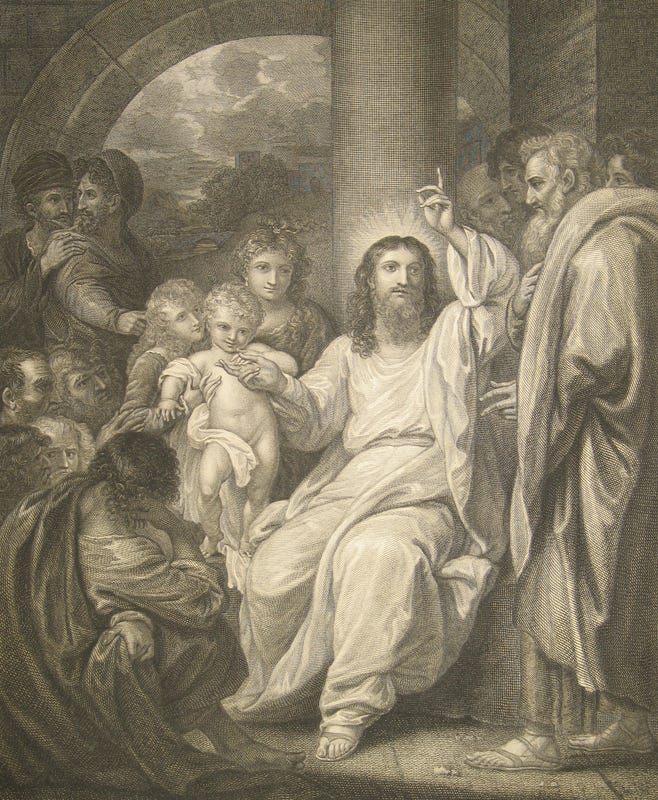
And Jesus decides he’s going to teach them a lesson. So he tells them that if they want to be part of the kingdom, the first in the kingdom of God will be servant of all. They must first become servants of all. And then to illustrate that, there’s a child running around the house, and Jesus invites the child and comes and sets the child in the midst of the disciples and says, “Whoever receives one such child in my name receives me, and whoever receives me receives not me but the one who sent me.”
The Wordplay of Child and Servant
Now, I’m told—and I read that the Aramaic word (just so you know, I don’t speak or pretend to read Aramaic)—but I’m told that the Aramaic word for “child” is the same as the Aramaic word for “servant.” So Jesus had just told them that they must become servants of all, and then he takes a child—so there’s some wordplay going on here—and sets the child in the midst of them and says that they need to receive the child. “Whoever receives one such child, one such servant, in my name receives me, and whoever receives me receives not me but the one who sent me.”
Now this context, I think, highlights the fact that Jesus, in talking about the child, is not highlighting innocence like we might think of naturally in our context, or highlighting even childlike faith, again as we might think of. In fact, those associations with childhood were not really present in the ancient world. Those are actually products of the early church and how the early church came to think about children.
And so for Jesus to then take up a child and put the child there and say, “Whoever receives one such little child receives me”—Jesus is saying, “This child is my representative.” And when you receive me by receiving this child, you receive not me but the one who sent me, the Father.
Assumptions About Status and Representation
So Jesus is playing with a lot of assumptions here. The first being that the assumption of the ancient world was not about children as innocent, children as having faith. It was about children as people who couldn’t do a thing for you—children as the lowest on the totem pole, so to speak. It was a very different concept. So who’s a servant of all in the household? The youngest. The youngest is the servant of all because they’re the lowest on the totem pole. So Jesus is telling them something really about humility.
And he’s telling them this, and then he’s telling them something else—something that has to do with representation. The ancient world was full of assumptions about patronage and about representation. And for a representative to go somewhere, that means you would receive them like they were the very person they were representing.
When people would send letters, for example, when Paul sends his letters to the churches, many scholars think it would have been likely that not only did Paul dictate the letters, but that whoever took the letter and delivered it would have talked to Paul ahead of time, read it, probably memorized it, and would have known what things to emphasize when they spoke. And they would have actually spoken the letter, spoken the message to the church that Paul had sent, emphasizing the very things that Paul said. This was an extension of the idea that in sending the letter with the representative, Paul was sending someone who was to be received like him, like Paul himself.
So Jesus is highlighting this and saying, “Whoever receives one such child, one such servant, one such person that you assume cannot do anything for you—you receive me. And in receiving me, you receive not me but the one who sent me.”
Finding Jesus in the Least
So Jesus is saying, “If you want to know who represents me, who represents Jesus, look for the one who can’t do anything for you. Look for the one that doesn’t offer advantage. Look for the one that doesn’t offer you higher status. Look for the one that is only in need of help and offers only themselves.” And then you will know what it means to welcome Jesus.
And in welcoming Christ, we know who we welcome when we welcome Christ. We welcome God in the flesh. We welcome not only the Son but the Father who sent the Son, because Jesus is the messenger. Jesus brings God’s word. Jesus is God’s word. So in receiving Christ, we receive God.
A New Economy in God’s Kingdom
So the lesson for us extends beyond this. If we want to find Jesus, we look for the one who can give us nothing. The other side of it is that as followers of Jesus, not only should we not be concerned with status in the way the world is concerned with status, not only is Jesus flipping upside down the assumptions of the world about who matters—the last shall be first and the first shall be last, all of this teaching Jesus does on this—Jesus is also, I think, trying to teach us a lesson. Because Jesus has said, “You should become like a servant of all.” In other words, become as one that cannot offer anything to anyone.
Now, that doesn’t mean we don’t have any skills or care or love. We don’t have things to offer. Doesn’t mean we don’t have gifts—that word betrays it: gifts. The idea is that unlike the way people were thinking about things in that day and age, which is, “I’m going to help someone who can help me somehow, and I’m going to help someone in the hopes that what I give will ingratiate myself to them so that they can sort of lift me up”—instead of that, Jesus is teaching his disciples and teaching us about a whole new economy in the kingdom of God. One that isn’t concerned with what others can do for us, and one that gives freedom, where we give freely to others because we have received freely from God.
So we are going to welcome others regardless of what they can do for us, and we’re going to give freely to others without regard to the idea that somehow what we give belongs only to us, but instead remembering that what we have and who we are is all gifts of God. And therefore, in order to love our neighbor and to demonstrate our love for God, we share with others freely, without expectation of return.
So we receive the servant, and we become the servant. We receive the child, and we become like the little child in the kingdom of heaven—free of all the expectations that society builds and all the desires that otherwise rule.
Good News for All
This is good news, not only for people back then who were hidebound in their own expectations about society, but it’s good news for us too. Because it demonstrates that in the kingdom, what God is bringing into reality is something where people are valued because they are beloved by God. And there is neither any need for any other reason to love, nor is there any way that we cannot come to this call to love one another, because God has first loved us.
So the lesson for us is, I think, to think about in our own day the people who are not conceived of as being able to be any benefit to us—people who are pushed to the edges, pushed to the margins. You might think of the elderly, you might think of the disabled, you might think of those who are sick with chronic illness. People who are forgotten, not necessarily because they’re hated, but because they make us uncomfortable.
I think oftentimes the people who are pushed to the margins in our society are often the people who remind us of precisely that lesson that Jesus is trying to teach us: the fact that our worth is not based upon what we can do and what we can offer others, but only and solely based upon the fact that God loves us.
Measuring Worth
And we would a whole lot, I think, rather it be the case that we can measure our worth based upon what we can do, the list we can make of what we can offer. And we can apply that most harshly to ourselves. We can also fall into the habit of applying it to others as well. And this, I think, is what Jesus is warning us about today as his disciples.
Who are we willing to welcome, knowing that we will welcome Christ? What are we willing to offer to others, knowing that we will be serving Christ in them? This is what we should be considering. This is the message that Jesus offers us.
And in telling it to the disciples, he’s telling them, “Don’t argue over who has the most status. Don’t argue over who’s the greatest, because in doing that, you’re holding on to this old way of thinking that’s going to pass away.”
And Jesus is telling us the same thing. This old way of thinking has continued, and it’s still there in our society. It’s changed shape, it’s changed form, but it’s still there. So for us, we are to embrace the reality that our worth is summed up in the fact that Christ came and died for us. And so is everyone else’s.
Amen.


