


Scriptures: Amos 5:6-7,10-15 · Psalm 90:12-17 · Hebrews 4:12-16 · Mark 10:17-31
May the words of our mouths and the meditations of our hearts be always acceptable in your sight, O Lord, our strength and our redeemer. Amen.
There are times when the phrases we use—the sort of stock phrases that roll off our tongues—carry more freight than we imagine, more background behind them than we usually understand. One phrase that stands out in my mind does so because of a particular memory. I was in the third grade and was called up to the teacher’s desk during a quiet work time. I walked up and saw her looking at a note, then looking at me over her glasses, and she said, “What possessed you to throw a rock at a school bus?”
As it happened, I hadn’t really thrown a rock at the school bus. I had been throwing a rock at my cousin, who was leaning halfway out the window. But nonetheless, that was the phrase she used, and it struck me quite hard at the time. I had only ever heard “possessed” in the sense of ownership, not in the sense of something taking control of you. I remember being taken aback by that phrase, and reflecting on it even while I was in trouble—because that’s the sort of kid I was. I remember thinking, even before I got called up, “That was dumb. Why did I do that?” And so: possession. That’s what it means. When someone asks, “What possessed you to do that?” it means you’ve done something out of character, unexpected, perhaps irrational.
Behind that phrase, though, there is a long history of what we might now most often associate with Hollywood depictions like The Exorcist. There is this idea that something outside of oneself can take hold. The exorcist Gabriele Amorth, who died in 2016, has a concise way of distinguishing what we might call spiritual possession from more mundane problems. He says that spiritual possession, if we are willing to use that term, is something that does not respond to medical treatment but seems to respond quite well to blessing. That is an interesting way of looking at it: something that does not respond to medicine, but does respond to blessing.
I want to talk about possession in a different, more mundane way—not so much possession as a spiritual oppression from outside of us, but possession by something very physical, very ordinary, and no less fraught: the way our possessions, our things, can take hold of us and direct our actions. What makes me think of that is our gospel text today, where Jesus encounters the rich young man.
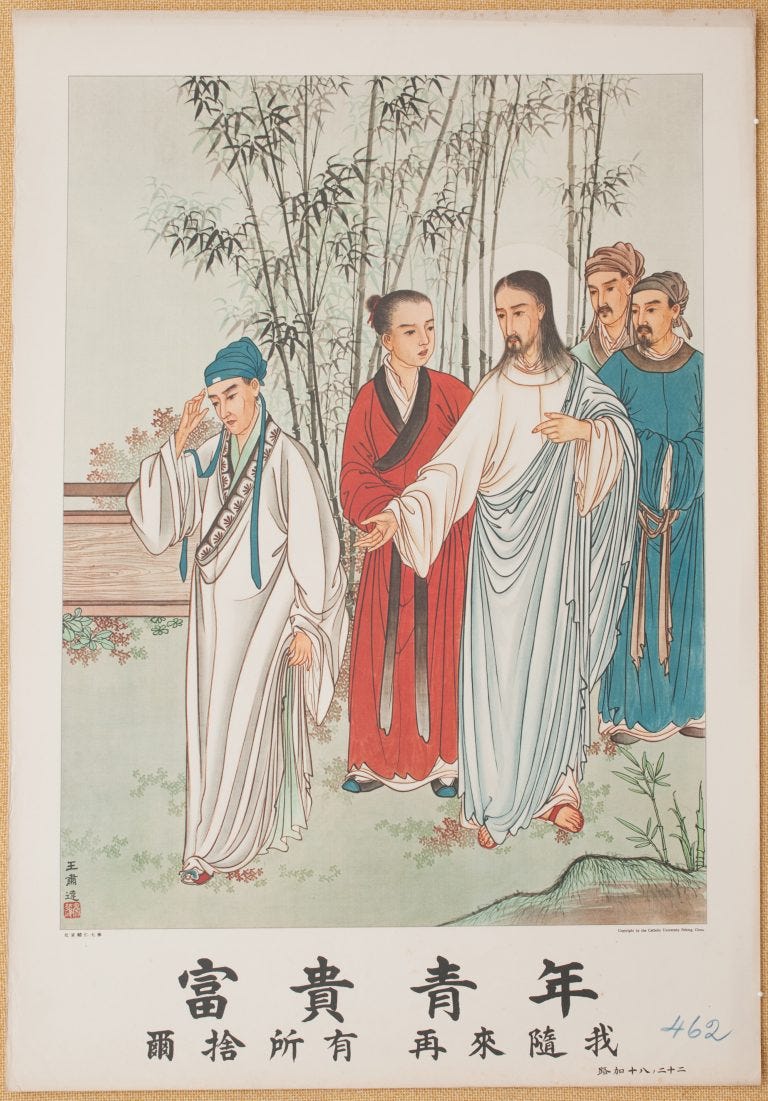
This young man comes to Jesus in a very interesting way. Mark tells us that he runs up to Jesus and kneels before him. His urgency is very similar to that of people seeking healing from disease. He runs, he kneels, and he asks, “Good Teacher, what must I do to inherit eternal life?” Jesus responds, “Why do you call me good? No one is good but God alone. You know the commandments: you shall not murder, you shall not commit adultery, you shall not steal, you shall not bear false witness, you shall not defraud, honor your father and mother.” In other words, “You know what you have to do.” The young man replies, “Teacher, I have kept all these since my youth.”
Mark then says something striking: “Jesus, looking at him, loved him, and said, ‘You lack one thing; go, sell what you own, and give the money to the poor, and you will have treasure in heaven; then come, follow me.’” Mark goes on to say that when the man heard this, he was shocked and went away grieving, “for he had many possessions.” One of the consistent witnesses of scripture about wealth and possessions is that while we often think of ourselves as owning things and doing what we like with them, scripture warns that we can just as easily be owned by them. We can be possessed by our possessions, as much as we possess them. Our actions can be directed or misdirected, guided or misguided, by the things we own. That, I think, is the challenge of today’s gospel for all of us.
Jesus goes on to explain this encounter to his disciples. He says, “How hard it will be for those who have wealth to enter the kingdom of God!” and then, with that vivid image, “It is easier for a camel to go through the eye of a needle than for someone who is rich to enter the kingdom of God.” This is a difficult saying, and so people have come up with all sorts of glosses over the years—talking about city gates supposedly called “the eye of the needle,” and camels being unloaded to squeeze through. But many scholars challenge that explanation and say it’s wishful thinking. The challenge Jesus gives is real.
The disciples are astounded and ask, “Then who can be saved?” In the ancient world they, like many of us, often assumed that wealthy people might have an inside track with God. They had the means to offer sacrifice, to support religious and public works, to do all the things religious people were supposed to do. There was also a persistent belief that material prosperity might be a sign of God’s favor. So when Jesus says how hard it is for the rich to enter the kingdom, they are understandably shaken. Jesus answers them, “For mortals it is impossible, but not for God; for God all things are possible.” To me, that is a far more hopeful line than any attempt to imagine a camel squeezing through a tiny gate. The point is not that we can solve the problem with cleverness or effort; the point is to depend on God. That is where our hope lies.
This passage about the rich young man has intrigued me for a number of years. In the past I’ve tended to read the young man as being sincere when he says he has kept all the commandments from his youth, and perhaps that is why Jesus looks at him and loves him before speaking the hard word. Recently, though, I came across an intriguing interpretation that puts a different spin on the passage.
If you pay close attention to Jesus’ list of commandments, you’ll notice he adds—or at least expands—one item. He says: you shall not murder, you shall not commit adultery, you shall not steal, you shall not bear false witness, and then, “you shall not defraud.” “You shall not defraud” is not part of that particular section of the Decalogue as it appears in Deuteronomy. Scholars debate where Jesus might be drawing it from, whether from another scriptural source or simply as his own insertion. Some suggest it might be an expansion of “you shall not bear false witness,” since defrauding someone often involves deception, a kind of false witness against your neighbor.
This becomes especially interesting when you compare this scene with Jesus’ encounter with another wealthy man: Zacchaeus. Zacchaeus is a tax collector. He climbs a sycamore tree to see Jesus. Jesus calls him down and says, “I must stay at your house today.” The people grumble because Jesus is going to eat with a “sinner,” a collaborator who, they assume, must have enriched himself by squeezing his neighbors. When Jesus comes to his house, Zacchaeus stands and says, “Half of my possessions I will give to the poor; and if I have defrauded anyone of anything, I will pay back four times as much.” Jesus responds, “Today salvation has come to this house.”
People assume Zacchaeus is a sinner because of his wealth and his profession, whether or not he has actually done anything illicit. Perhaps something similar is going on with the rich young man. Perhaps he has not kept all the commandments quite as faithfully as he imagines. Jesus’ insertion of “you shall not defraud” may be more than a random addition; it may be an opening for the young man to recognize and make amends for hidden or unacknowledged sin. Some scholars note that this section of Mark echoes themes from the prophet Malachi, especially Malachi 3:5, where the Lord says he will draw near for judgment against sorcerers, adulterers, those who swear falsely, those who oppress hired workers in their wages, the widow and the orphan, and those who thrust aside the alien and do not fear God. There we see concerns about adultery, about care for the vulnerable, about justice in economic dealings—all themes that show up in Jesus’ teaching in this part of Mark.
So perhaps in inserting the command not to defraud, Jesus is doing what he so often does in the gospels: displaying an intense insight into people’s hidden sins, and giving the young man an opportunity. “You lack one thing. Go, sell what you own, and give the money to the poor, and you will have treasure in heaven; then come, follow me.” But the young man cannot hear that word as liberating. He cannot receive it as a cure. Mark tells us he is shocked and goes away grieving, for he has many possessions. He is possessed of many things, we might say, and he becomes the one person in the gospels who receives a direct, explicit call to follow Jesus and refuses.
What is the lesson for us, and where is the hope? As I said earlier, we usually talk about possession in cultural terms of spirits and exorcism, and it has largely become a matter of entertainment rather than belief. But we can be possessed by very mundane things as well, and perhaps those things are more dangerous than “the spirits of the air,” because we are more likely to be on guard against the spectacular and the strange, and less on guard against what feels normal and everyday.
Amorth’s observation about medicine not working reminded me of a song I’ve quoted before, so I hope you don’t mind hearing it again. It’s by the Avett Brothers, from North Carolina, and it’s called “Ill With Want.” Their grandfather was a Methodist preacher, and sometimes I think a bit of Augustine sneaks into their lyrics, whether consciously or not. In that song they sing:
I am sick with wanting
and it’s evil how it’s got me.
How I let everything I cherish lay to waste.
I am lost in greed this time, and it’s definitely me.
I point fingers, but there’s no one there to blame.

I need for something.
Now let me break it down again.
I need for something, but not more medicine.

I am sick with wanting,
and it’s evil how it’s got me.
Every day is worse than the one before.
The more I have, the more I think I’m almost where I need to be,
if only I could get a little more.

I need for something.
Now let me break it down again.
I need for something, but not more medicine.
Something has me acting like someone I don’t want to be,
like someone I know isn’t me.
Ill with want and poisoned by this ugly greed.
Then comes the explicitly Augustinian turn:
Temporary is my time,
ain’t nothing on this world that's mine
except the will I found to carry on.
Free is not your right to choose;
it’s answering what’s asked of you,
to give the love you find until it’s gone.
I love this imagery, especially that line in the chorus, “I need for something, but not more medicine.” The speaker recognizes that all the things he is grabbing for are merely band-aids. They are medicine, not cures. What he needs is a cure.
The rich young man needed a cure, too. “What must I do to inherit eternal life?” he asks. Jesus offers him the possibility of a cure, but it is a cure he cannot bring himself to accept. The question for us is: what are the things that are possessing us? What are the things that are deforming our actions, that are keeping us from hearing the word that leads to our salvation, the word that would help us live the life God is calling us to live? For some of us it may indeed be material possessions. For others it may be any number of other things that haunt us, court us, or distract us. What are the things that have directed our actions away from what God has called us to? Those are the things we need to be rid of, in order to be faithful and to embrace the hope Christ offers.
Because in the end, it is not actually dependent upon us. It is dependent on God. God has given us the cure we need. The challenge is real, but the hope is just as real. Can we hear the word Christ offers—the word of hope that “for mortals it is impossible, but not for God; for God all things are possible”?
And yes, this is a challenge for us, and I would even submit that there are times in the church when we preach against wealth in a somewhat hypocritical way. We can sound as if all wealthy people are automatically wicked, and then we turn around and send out a stewardship letter. But the lesson of scripture is that whatever we are given—whether we are talking about financial resources or about gifts and talents—whatever we are blessed with, we are encouraged and in fact commanded to use that blessing to bless others. So whether we can invite someone who is hungry over for a hot dog or for a filet mignon, it is the same command: to be generous, to love one another, to give what we have, to be a blessing by that with which we have been blessed—to give the love we find until it is gone. Amen.
Background notes:
The text below consists of my sermon notes and some of the background research I did, but it is not itself a manuscript.
Sometimes our language can reveal more than we intend. Certain phrases carry more weight than we realize, more historical and intellectual freight. Unfolding it all can be an interesting exercise. And sometimes spoken phrases can catch us up short, like the written word that stands out strangely on page or screen even though it is spelled correctly, taunting us with its alien nature, its out of shape edges.
One such phrase that stands out for me is “What possessed you…” The first time I heard it used–or at least the first time I remember hearing it–was when I was in the third grade. My teacher had called me up to her desk during a quiet moment in class, when we were all working on something or other at our desks. She was looking down at a note, and then she looked at me over her glasses and said “What possessed you to throw a rock at the school bus?”
Now, as a matter of fact the afternoon before when I’d gotten off the Bus I had thrown a rock, but not at the School Bus precisely. I’d thrown it at my cousin who it happens was on the School Bus at the time. He had been irritating me the whole drive home and was at the moment the rock left my hand, leaned out one of the rear windows making a face or shouting some taunt. In one way, I knew very well why I had thrown the rock. I was angry and I’d had enough. Cousins that you grow up with, like other close friends and relatives, often know just the buttons to push, and this was an example.
But in another sense, as soon as the rock left my hand, I’d wondered why I’d done it. The phrase “what possessed you…” was an appropriate one, though at the time I was confused by it. I remember being a little offended by the phrase, though I didn’t know why. Nothing, I thought, had made me, at least, nothing except my loving cousin.
But of course, something had possessed me. I acted without reflecting. I was impulsive. Anger had me in its grip. I gave myself over to my baser instincts and, well, my action was an indication that my faculties had indeed been possessed by them. I wasn’t in control.
The language of possession that holds on in such a seemingly innocuous phrase is intriguing. What do we really mean when we ask what possessed someone? Of course we can mean something rather mundane–what emotions drove them to act out of accord with rationality? But we can also mean something beyond the normal parameters of this world, something mysterious or even something founded on the evil powers of this world. The phrase can, in other words, be a sign that we are looking for some explanation where no reasonable explanation exists.
And when no reasonable explanation exists, it can be a sign to look beyond what we normally think of as reason. Father Gabriele Amorth, late Vatican Exorcist (d. 2016) has written for example, that “one of the determining factors in the recognition of diabolic possession is the inefficacy of medicines while blessings prove very efficacious” (Amorth, An Exorcist Tells His Story).
Lest you think I’m going to slip into a reflection on the unseen powers of this world, and how our post-enlightenment rationality can coexist with a biblical view of the unknown–if indeed it can–that is another conversation. Instead, I want to emphasize that sometimes the things that possess us appear to be far more mundane, far more this-worldly than other worldly. Our gospel text this morning invites us to consider that our possessions may be the source of our possession. In other words, the things we own, the things we covet–they may control us; control our thinking, feeling, and acting in a manner as diabolical as any spirit of the air.
As Jesus was setting out on a journey he is respectfully approached by a young man who asks him “what must I do to inherit eternal life?” Jesus tells him “You know the commandments: ‘You shall not murder; You shall not commit adultery; You shall not steal; You shall not bear false witness; You shall not defraud; Honor your father and mother.” Things get more complicated when the young man, who is quite wealthy, claims to have kept all these commandments from his youth. But it is possible that Jesus knows otherwise. Commentators debate whether the rich young man is depicted in a positive or negative light. Sometimes it is suggested that the man’s wealth itself calls into question his claim to have kept all these commandments–and the pairing with Amos in the lectionary might lead us in that direction. But before we write the man’s claim off, I think we need more evidence than his wealth. Remember that when Jesus interacts with the wealthy, he doesn’t tend to condemn them for their wealth out of hand, but he does have a tendency to push against the possibility that any of their wealth may have been ill gotten, and to encourage their hospitality. Consider the case of Zacchaeus as an interesting parallel. Jesus sees Zacchaeus and invites himself to supper. Zacchaeus obliges and does not protest (though the crowds grumble, for he is known as a sinner because he is a Tax Collector). But Zacchaeus says something interesting:
Zacchaeus stood and said to the Lord, “Behold, Lord, the half of my goods I give to the poor. And if I have defrauded anyone of anything, I restore it fourfold.” And Jesus said to him, “Today salvation has come to this house, since he also is a son of Abraham. For the Son of Man came to seek and to save the lost” (Luke 19:8-10).
Did you notice something about Jesus’ summary recitation of the commandments? It’s not point for point from Deuteronomy, instead, Jesus imports a command or interprets and expands the commands to include the statement “You shall not defraud.” It is possible that Jesus is gently challenging the Rich Young Man, knowing that his wealth may not have been accumulated by entirely just means. When the man says that he has kept all these commands from his youth, Jesus looks at him, and we’re told he loved him.
One commentator makes a good argument for the intertextuality of portions of the Gospel of Mark and Malachi 3. Here, intertextuality is defined as the “embedding of fragments of an earlier text within a later one.” In this sense then, this section of Mark may have portions of the book of the Prophet Malachi lying behind it. Specifically, Malachi 3:5 may be in view, and could bolster the view that the young man’s sin of defrauding others in order to gain wealth is in view:
“Then I will draw near to you for judgment; I will be swift to bear witness against the sorcerers, against the adulterers, against those who swear falsely, against those who oppress the hired workers in their wages, the widow and the orphan, against those who thrust aside the alien, and do not fear me, says the Lord of hosts.”
(Mal. 3:5)
And yet, it should encourage us that Jesus doesn’t chastise him, correct him, say “surely you could only say you’ve kept all of this if you’re deceiving yourself.” No. Jesus looks at him and loves him. Just as Jesus has looked at people and felt compassion for them because they were like sheep without a shepherd, here Jesus looks at this man and loves him, and gives him an opportunity to be a disciple. Come. Follow me. If we believe that he has defrauded others and is deceiving himself about his culpability, it is an opportunity for repentance and amendment of life. If we believe that he is being truthful and Jesus accepts his statement, then it is an opportunity to enter more deeply into discipleship. But it is more than the man can handle. Mark tells us that when “he heard this, he was shocked and went away grieving, for he had many possessions.”
In reflecting on this passage we should remember the context that we have talked about for several weeks in regard to this section of Mark. It’s all about right relationship. As my New Testament professor wrote about this section, it moves from sections dealing with right relationship to the vulnerable or powerless, represented by children, to our appropriate relationship to other disciples, particularly those who don’t follow our plan (we’re meant to realize that Jesus’ plan and our plan–particularly when it comes to others–may not be the same), our relationship to “little ones” (both literal children and believers in Jesus), to each other (have salt in yourselves and be at peace with one another), relationships to wives who were the vulnerable partners in marriages of the period (and by extension, between spouses in general), to children again, and to possessions today.
“In all these passages the underlying emphasis, in vivid contrast to the disciples’ concern as to who shall be “greatest,” is on the strong yielding to the weak, the privileged transferring privilege to the underprivileged, the very wealthy foregoing the fruits of wealth for the sake of the gospel. It is striking that at the climax of this the disciples do seem, momentarily, to see the point. ‘Then who can be saved?’ they ask. The answer, Jesus tells them, lies not in their attempts at obedience, but in God for whom ‘all things are possible’ (10:26-27). Is it then the case that those who attempt obedience are wasting their time? By no means: they will receive their recompense–with suffering! (10:28-30). the summary of it all is, ‘Many that are last will be first, and the first last’; in the context, a splendid paradox, threatening to those who seek to claim to be ‘greatest,’ yet full of promise for those who seek (but do not claim to be very good at) obedience”
(Christopher Bryan, “A Preface to Mark” 102-103).
“As is made clear in the story of the rich young man, Mark is aware of the danger of those riches that make it ‘hard’ for us to enter the kingdom (10:17-22; compare 4:19); but even that sequence has some of its sting drawn. ‘Hard’ it may be for the rich to enter the kingdom, yet ‘all things are possible with God’ (10:23, 25, 27). Indeed, the conclusion to that particular conversation implies that willingness to abandon all for the sake of Jesus is not followed by a life without human ties, even ‘now in this time,’ but rather by its opposite (10:30). While it may be conceded that this passage in particular refers to the believer’s new ‘family’ in the Church (compare 3:31-35), still the followers of Jesus in Mark are made powerfully aware that ordinary human marriage remains a lifelong commitment, precious in God’s sight (10:1-12), and that children, the natural fruit of marriage, are not to be ‘hindered’ (10:14; probably a baptismal phrase: compare Acts 8:36, 10:47) in their relationship with Jesus.”
(Bryan, 157-158)
All of this raises the question: maybe these concerns aren’t so mundane. Maybe they are spiritual after all. Amorth’s definition, that possession is defined by something that won’t respond to medical treatment–to medicine–but will respond to blessing reminds me of one of my favorite songs by the North Carolina band, the Avett Brothers. I’ve quoted the song before, so I hope you’ll bear with me as I reference it again. The Avett’s grandpa was a Methodist pastor, and sometimes they seem to be channeling a sort of Augustinian perspective, whether intentionally or not. In it they express the concern that “medicine” isn’t cutting it–what they need is a cure. What the Rich young man needs is a cure. What we need is a cure. Jesus offers it to us, if we’re willing to receive it.
I am sick with wanting
And it’s evil and it’s daunting
How I let everything I cherish lay to waste
I am lost in greed this time, it’s definitely me
I point fingers but there’s no one there to blame
I need for something
Not let me break it down again
I need for something
But not more medicine
I am sick with wanting
And it’s evil how it’s got me
And everyday is worse than the one before
The more I have the more I think,
I’m almost where I need to be
If only I could get a little more
I need for something
Now let me break it down again
I need for something
But not more medicine
Something has me (Something has me)
Oh something has me (Something has me)
Acting like someone I don’t wanna be
Something has me (Something has me)
Oh something has me (Something has me)
Acting like someone I know isn’t me
Ill with want and poisoned by this ugly greed
Temporary is my time
Ain’t nothin’ on this world that’s mine
Except the will I found to carry on
Free is not your right to choose
It’s answering what’s asked of you
To give the love you find until it’s gone.
The background information about Malachi in the Gospel of Mark was brought to light in the following Journal article:
Hicks, Richard. 2013. “Markan Discipleship According to Malachi: The Significance of Μh̀ Αποστερήσης in the Stroy of the Rich Man (Mark 10:17-22).” Journal of Biblical Literature 132 (1): 179–99. http://search.ebscohost.com/login.aspx?direct=true&db=a6h&AN=ATLA0001984130&site=ehost-live.


